I recently came across a Twitter handle and found these videos featuring Warren Buffett and Charlie Munger.
Pure gold. Essential listening.
https://x.com/i/status/2012503133315068277
https://x.com/i/status/2012113355738411215
I recently came across a Twitter handle and found these videos featuring Warren Buffett and Charlie Munger.
Pure gold. Essential listening.
https://x.com/i/status/2012503133315068277
https://x.com/i/status/2012113355738411215
2026 Plan
The Great Mental Models; Shane Parrish
Thinking in Bets; Annie Duke
Everything Is Obvious; Duncan J. Watts
The Psychology of Money; Morgan Housel
Prediction Machines; Ajay Agrawal
Power and Prediction; Ajay Agrawal
AI Superpowers; Kai-Fu Lee
The Coming Wave; Mustafa Suleyman
Human + Machine; Paul Daugherty
Co-Intelligence; Ethan Mollick
Agentic Artificial Intelligence; Pascal Bornet
The Innovator’s Dilemma; Clayton M. Christensen
Competing in the Age of AI; Marco Iansiti
Platform Revolution; Sangeet Paul Choudary
Innovation and Entrepreneurship; Peter F. Drucker
Built to Last; Jim Collins, Jerry I. Porras
Zero to Scale; Arindam Paul
Measure What Matters; John Doerr
A Sense of Urgency; John P. Kotter
Trillion Dollar Coach; Eric Schmidt
Eleven Rings; Phil Jackson
Complete three certifications; to be finalized.
Complete one Agentic AI course; to be finalized.
Finally finished reading the book Reshuffle by Sangeet Paul Chowdary. My summary points below.

Summary of my notes: AI's biggest impact isn't about making things smarter or replacing jobs. It's about coordination, how work gets organized, how decisions flow and who controls the system. The winners are the ones who redesign how things work, not just the ones who buy better tools.
The Container Ship Analogy: Singapore became a hub not by optimizing docks, but by positioning itself at the center of coordination. Shipping containers didn't win because they were faster. They won because they forced standardization across ports, rail, customs and contracts. They made coordination predictable. AI does the same thing for knowledge work that containers did for global trade.
The Coordination Gap: Modern work is messy with siloed teams, disconnected tools, misaligned incentives. Traditional software only handles structured, rule-based environments. But most real work involves ambiguity, judgment calls, tacit knowledge, and negotiation. That gap is where AI actually matters.
Sense the environment
Build a working model
Evaluate trade-offs
Execute decisions
Learn from feedback
This isn't about perfect reasoning. It's about making fragmented systems work together.
Jobs Get Unbundled and re-bundled: Jobs are bundles of tasks plus coordination plus judgment. AI strips out the coordination-heavy parts. Value shifts away from doing tasks toward orchestrating the system. That's why reskilling alone doesn't work. The system itself undergoes changed and one needs to reposition where value accumulates after everything gets rebundled.
Organizations Need to Be Rebuilt: AI isn't a new hire, but a reorganization trigger. Traditional org charts optimize for control and hierarchy. AI enables flatter, more modular structures driven by outcomes. Authority shifts from hierarchy to system design, who sets up the coordination layer matters more than who manages people.
Competitive Advantage Comes from System Design: Buying AI tools doesnt create advantage for organizations. Everyone buys the same software. Advantage comes only from managing uncertainty, owning the decision context, and designing the interfaces where others depend on your system.
Control Without Consensus: Traditional coordination requires everyone to agree upfront. AI enables coordination without consensus by translating across fragmented actors. Value attracts participants first; consensus follows later. Power goes to whoever controls the shared representation layer and the system others plug into.
Designing for Indecision: AI increases options and it increases confusion. The real advantage is helping users decide under ambiguity. Companies that reduce cognitive load capture trust, attention and dependency. Decision orchestration becomes the new lock-in.
AI Strategy: AI isn't a standalone strategy. Before defning AI strategy, the right questions to ask are: 1) Where does coordination break today? 2) Where does uncertainty block value? 3) Who controls the decision flow?
Strategy shifts from "what tech to adopt" to "where do we re-architect the system".
Came across a solid CXOTalk discussion: “Why AI Works, but Your Strategy Isn’t.”
Host: Michael Krigsman
Guest: Sangeet Paul Choudary
Link: https://www.youtube.com/watch?v=mV6g4uQEUUo
Summary
AI fails when it’s deployed as a tech add-on instead of a system redesign. Efficiency gains trigger new coordination costs that outgrow the benefits if strategy, structure, and governance aren’t rebuilt. Real value appears only when technology, process, people, and decision rights are treated as a single system.
Key Points
Efficiency paradox: Automation cuts task effort but increases coordination overhead across teams.
Strategy mismatch: AI treated as a tool, not a strategic shift. Weak change management leads to shallow outcomes.
System thinking: AI operates inside an ecosystem. Design for “scale without consensus” using guardrails, rules, and clear authority lines.
Leadership and governance: Senior leadership must own the AI agenda; data, model, and operational governance enforce trust and repeatability.
Measurement: Look beyond cost. Track decision latency, adaptability, coordination load, and risk shifts.
Key Takeaways
Stop treating AI as plug-and-play; treat it as organisational redesign.
Build AI strategy as a unified system: tech + process + people + governance.
Map human–system interaction changes; identify coordination points and ownership.
Define decision rights: who acts on outputs, how exceptions route, how escalation works.
Create feedback loops to catch unintended consequences and correct fast.
https://www.youtube.com/watch?v=9RvWcXVaAng&t=68s
Conclusion: Transforming your organization with (generative) AI
AI can seem very intelligent, but you need to be intelligent in how you use it
Start with the problem, not the technology: many solutions will be combinations of technologies, processes, and people
Get started now: pilots, policy, org capability
Help your people be ready and willing to participate
Continuously iterate and improve: “Small t” transformations address risk and build capability for “Larger T” transformations later
Recently listened to this podcast.
'Andrej Karpathy — “We’re summoning ghosts, not building animals"'
https://youtu.be/lXUZvyajciY?si=kDL68fMfVhq3sUGO
Amazing podcast and I would recommend you to patiently go through the 2 Hour 26 minutes podcat at 0.80X Speed.
I am always a fan of Andrej. And I really liked the clarity of his thoughts and the conviction with which he has explained various topics such as AGI, Evolution of intelligence, Future of Education etc.
Here is the summary of the following topics discussed in detail
00:00:00 – AGI is still a decade away 00:30:33 – LLM cognitive deficits 00:40:53 – RL is terrible 00:50:26 – How do humans learn? 01:07:13 – AGI will blend into 2% GDP growth 01:18:24 – ASI 01:33:38 – Evolution of intelligence & culture 01:43:43 - Why self driving took so long 01:57:08 - Future of education
They discuss a wide range of topics, and it's always a treat to listen to Andrej's point of view. They delve deep into a variety of aspects.
Personally I am waiting for the teaching agent or the Tutor which Andrej is working on and how it revolutionizes the education.
Excerpts from the Gartner Session.


While researching more on the GenAI for business Enterprise platforms, I came across the below link which highlights the Forrester Wave™ evaluation of cognitive search platforms (Algolia, Amazon Web Services, Coveo, Elastic, Glean Technologies, IntraFind, Kore.ai, Lucidworks, Microsoft, Mindbreeze, OpenText, Sinequa, Squirro and Yext).
It assesses leading providers based on 27 criteria, analyzing their strengths, weaknesses, and strategic direction.
The cognitive search market is undergoing a transformation driven by generative AI, with increasing demand for search-driven applications and the adoption of technologies like large language models (LLMs) and vector databases.
Vendors are evolving beyond basic search functionalities to offer robust indexing, intent-based search, and extensive data connectivity. The report highlights their capabilities in intent understanding, data integration, and advanced retrieval methods.
Leaders excel in intent-based search and LLM integrations, while other vendors focus on specific industry needs or customization capabilities.
As new players enter the market, buyers must prioritize platforms that offer comprehensive indexing, deep intent analysis, and strong data pipelines.
The report provides a comparative analysis, encouraging buyers to customize evaluations based on their requirements using Forrester’s detailed scorecard.
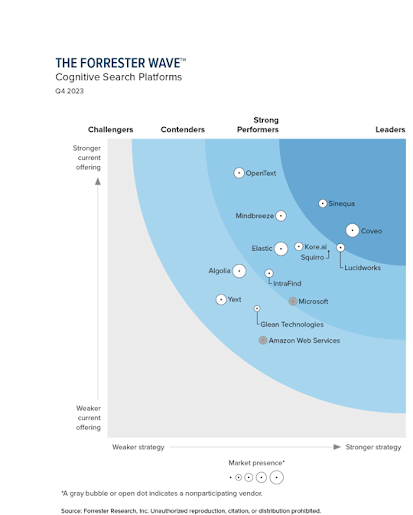

USPs of few leading Congnitive Search Engine Providers.
While exploring Knowledge Graphs, I came across Tony Seale's insightful series on Embracing Complexity - a fascinating read!
"...The Knowledge Graph is not a product that you can buy off the shelf. It is a way of organizing your data and algorithms in a unified network for each organization to bring its genius to this process..."
In a world of increasing complexity, organizations must move beyond traditional tabular data structures and embrace Knowledge Graphs—dynamic, interconnected networks that unify data, cloud, and AI. The articles highlights how graph-based data models unlock hidden insights by capturing relationships, feedback loops, and abstractions that traditional databases overlook.
Key tools like Graph Adapters, Data Services, and Graph Neural Networks enable seamless integration of diverse data sources while enhancing AI-driven decision-making.
A well-structured Knowledge Graph provides a holistic view of an organization, fostering systemic thinking, better change management, and more informed decision-making. As businesses accelerate into the digital age, building a Knowledge Graph is no longer optional but it is essential for survival and growth.
The graph-shaped data enables richer context, while a graph-shaped cloud ensures seamless connectivity across distributed data sources.
Traditional AI struggles due to its reliance on linear, structured data, but Graph Convolutional Networks (GCNs) offer a breakthrough by incorporating networked relationships into AI learning.
By embedding intelligence directly into the data-cloud network, organizations can unlock context-aware AI, enabling smarter predictions, systemic automation, and deeper insights. This network-based approach represents a paradigm shift, making AI more adaptive, intuitive, and lifelike for organizations navigating complex data ecosystems.
Its quite an informative read. Please read through all parts.
https://medium.com/@Tonyseale/embrace-complexity-conclusion-fb8be6f39debIt is is a bestselling guide that offers straightforward, practical advice on how to excel in sales and business development.
A "Rainmaker" is a term used to describe the seller who consistently brings in new clients, generates revenue, and drives business growth—an invaluable asset to any organization.
Key Lessons from the book:
𝗧𝗵𝗲 𝗨𝗟𝗧𝗜𝗠𝗔𝗧𝗘 𝘄𝗲𝗯𝘀𝗶𝘁𝗲 𝗼𝗻 𝘁𝗵𝗲 𝗔𝗜 𝗔𝗴𝗲𝗻𝘁 𝗺𝗮𝗿𝗸𝗲𝘁 𝗶𝘀 𝗵𝗲𝗿𝗲 — 𝗜 𝘄𝗼𝘂𝗹𝗱𝗻’𝘁 𝗯𝗲 𝘀𝘂𝗿𝗽𝗿𝗶𝘀𝗲𝗱 𝗶𝗳 𝗶𝘁 𝗯𝗲𝗰𝗼𝗺𝗲𝘀 𝘁𝗵𝗲 𝗴𝗼-𝘁𝗼 𝘀𝗼𝘂𝗿𝗰𝗲 — 𝘁𝗵𝗶𝗻𝗸 𝗼𝗳 𝗶𝘁 𝗮𝘀 𝗮 𝗳𝗼𝗿𝗺 𝗼𝗳 𝗪𝗶𝗸𝗶𝗽𝗲𝗱𝗶𝗮, 𝗯𝘂𝘁 𝗳𝗼𝗿 𝗳𝗼𝗿 𝗔𝗜 𝗔𝗴𝗲𝗻𝘁𝘀!
https://aiagentsdirectory.com/landscape
Source: Andreas Horn
AI agents are more than robots, software, or simple automation. They’re 𝗮𝘂𝘁𝗼𝗻𝗼𝗺𝗼𝘂𝘀 𝗱𝗼𝗲𝗿𝘀 that can 𝗹𝗲𝗮𝗿𝗻, 𝗿𝗲𝗮𝘀𝗼𝗻, 𝘁𝗮𝗸𝗲 𝗮𝗰𝘁𝗶𝗼𝗻, 𝗮𝗻𝗱 𝗺𝗮𝗸𝗲 𝗱𝗲𝗰𝗶𝘀𝗶𝗼𝗻𝘀. And currently everyone’s talking about them. Despite the growing buzz, real use cases are taking off already. Whether it is predictive maintenance in manufacturing, customer service, or AI agents disrupting software development, AI agents will be the autonomous specialists of the future.
The field is very dynamic and there are lots of new approaches, frameworks, and use cases added every week in this field. To keep a good overview the website below is helping a lot. It categorizes most existing AI Agent projects (450+) in the market and breaks them down into the following categories:
➤ 𝗕𝘂𝗶𝗹𝗱𝗲𝗿𝘀: 142 projects
➤ 𝗣𝗿𝗼𝗱𝘂𝗰𝘁𝗶𝘃𝗶𝘁𝘆: 56 projects
➤ 𝗖𝗼𝗱𝗶𝗻𝗴: 55 projects
➤ 𝗖𝘂𝘀𝘁𝗼𝗺𝗲𝗿 𝗦𝗲𝗿𝘃𝗶𝗰𝗲: 42 projects
➤ 𝗣𝗲𝗿𝘀𝗼𝗻𝗮𝗹 𝗔𝘀𝘀𝗶𝘀𝘁𝗮𝗻𝘁/𝗗𝗶𝗴𝗶𝘁𝗮𝗹 𝗪𝗼𝗿𝗸𝗲𝗿𝘀: 58 projects
➤ 𝗗𝗮𝘁𝗮 𝗔𝗻𝗮𝗹𝘆𝘀𝗶𝘀: 28 projects
➤ 𝗪𝗼𝗿𝗸𝗳𝗹𝗼𝘄: 20 projects
➤ 𝗖𝗼𝗻𝘁𝗲𝗻𝘁 𝗖𝗿𝗲𝗮𝘁𝗶𝗼𝗻: 19 projects
➤ 𝗥𝗲𝘀𝗲𝗮𝗿𝗰𝗵: 12 projects
𝗧𝗵𝗲 𝗯𝗲𝘀𝘁 𝗽𝗮𝗿𝘁: 𝗧𝗵𝗲 𝘄𝗲𝗯𝘀𝗶𝘁𝗲 𝗶𝘀 𝘂𝗽𝗱𝗮𝘁𝗲𝗱 𝘄𝗲𝗲𝗸𝗹𝘆 𝗮𝗻𝗱 𝗶𝘀 𝗮𝗹𝘄𝗮𝘆𝘀 𝘂𝗽-𝘁𝗼 𝗱𝗮𝘁𝗲! 𝗜 𝗯𝗲𝗹𝗶𝗲𝘃𝗲 𝗶𝗻 𝘁𝗵𝗲 𝘁𝗵𝗲 𝗺𝗼𝗻𝘁𝗵𝘀 𝗮𝗵𝗲𝗮𝗱, 𝗔𝗜 𝗮𝗴𝗲𝗻𝘁𝗶𝗰 𝘄𝗼𝗿𝗸𝗳𝗹𝗼𝘄𝘀 𝘄𝗶𝗹𝗹 𝗹𝗶𝗸𝗲𝗹𝘆 𝗱𝗿𝗶𝘃𝗲 𝗺𝗼𝗿𝗲 𝗽𝗿𝗼𝗴𝗿𝗲𝘀𝘀 𝘁𝗵𝗮𝗻 𝗲𝘃𝗲𝗻 𝘁𝗵𝗲 𝗻𝗲𝘅𝘁-𝗴𝗲𝗻 𝗳𝗼𝘂𝗻𝗱𝗮𝘁𝗶𝗼𝗻 𝗺𝗼𝗱𝗲𝗹𝘀.
𝗧𝗵𝗶𝘀 𝗺𝗶𝗴𝗵𝘁 𝗯𝗲 𝗮 𝗿𝗲𝗮𝗹𝗹𝘆 𝘂𝘀𝗲𝗳𝘂𝗹 𝗿𝗲𝘀𝗼𝘂𝗿𝗰𝗲 𝗳𝗼𝗿 𝘁𝗵𝗼𝘀𝗲 𝗼𝗳 𝘆𝗼𝘂 𝘄𝗵𝗼 𝘄𝗼𝗿𝗸 𝗶𝗻 𝗔𝗜 𝗮𝗻𝗱 𝘄𝗶𝘁𝗵 𝗮𝗴𝗲𝗻𝘁𝘀.
Demos and presentations are an integral part of every presales and sales professional’s life. Quite often, I have encountered situations where teams are required to deliver demos at short notice with minimal information. Whether it’s showcasing POC work or presenting a POV as part of an RFP evaluation, demos offer a valuable opportunity to highlight key capabilities to stakeholders in a short span of time. Solution demos play a crucial role in sales conversations, and making them impactful can often be challenging. However, if not executed well, they can have significant consequences.
A partner once recommended this book '"Great Demo!: How to Create and Execute Stunning Software Demonstrations" by Peter Cohan' to me, and I found it incredibly insightful.
I highly recommend the book to my colleagues in Presales and Solution teams, especially those involved in product, solution, and POC demos.
Gathering the necessary requirements from prospects is often tough, and with limited time, we must make the most of every opportunity. One of the common dilemmas we face is deciding what to showcase and what to leave out.
The book “Great Demo!" is about shifting the focus from a feature-heavy presentation to a problem-solving, customer-focused narrative. By keeping the customer’s needs at the center of the demo, the approach helps sales teams deliver more compelling presentations, shorten the sales cycle, and close deals more effectively.
This book provides a structured approach to software demos, focusing on demonstrating products in a way that captures customer interest, engagement, and buying intent. Below is a detailed summary of the core principles and strategies from the book to help guide effective and compelling software demonstrations.

This principle emphasizes delivering the primary value or result the customer seeks right at the beginning. Instead of starting with extensive background information, jump straight to what the customer wants to see. This approach captures the audience's attention quickly and immediately establishes the product's relevance to their needs.
Peter Cohan stresses the importance of identifying the prospect's Critical Business Issue (CBI) before creating or delivering a demo. Understanding this core problem ensures that every feature or functionality shown in the demo directly addresses the customer’s most pressing needs.
A successful demo should clearly present:
This structured workflow for software demos consists of four key steps:
An effective demo should not be a technical walkthrough but a focused presentation on how the product provides value to the customer. Rather than overwhelming them with features, concentrate on functionalities that directly solve their problem.
Cohan suggests using the inverted pyramid model, common in journalism, where the most important information is presented first, followed by supporting details. This keeps the audience engaged from the beginning and allows them to leave at any point without missing key takeaways.
Deliver a Minimal Viable Demo, showcasing only the essential parts of the product that directly address the customer’s issue. Avoid spending time on features that do not contribute to solving their critical business problem.
These demos are designed to help the customer envision success. By illustrating how your solution fits their specific needs, you enable the prospect to see the value it can bring to their organization, fostering early buy-in and commitment.
Encourage interaction by asking questions, seeking feedback, and allowing the prospect to use the software. This makes the demo feel like a collaborative exploration rather than a one-sided presentation, enhancing engagement.
Cohan recommends addressing customer questions and objections openly during the demo. Rather than avoiding tough questions, tackle them head-on while maintaining control of the demo flow, linking responses back to the product’s key value proposition.
Just like a movie, a software demo needs a storyboard. Plan out what you will show, the sequence of steps, and how you will communicate each point. This ensures a smooth, logical flow that keeps the audience engaged.
Keep the flow of the demo simple, avoiding unnecessary complexities. The demo should be easy for the audience to follow, focusing on how it solves their problem, not just how it functions.
Present the demo in the context of specific customer scenarios or use cases. By demonstrating how the software solves a real-world problem, the prospect will have a clearer understanding of the product’s value.
Throughout the demo, emphasize and repeat the key benefits and outcomes the customer will gain. Reinforcement ensures that these points resonate with the audience and that they leave the demo with a clear understanding of how your solution helps them.
At the end of the demo, summarize the main points and reiterate the value your product brings. Remind the prospect of the Critical Business Issue and how your solution resolves it.
After the demo, follow up promptly with materials that reinforce the key takeaways. These could include:
Build on the demo by creating a tailored proposal that addresses the specific needs and goals identified during the demonstration. This ensures continuity in the sales process and maintains momentum.
https://www.youtube.com/watch?v=Gn7GDQeG0vQ
I'm sure that since ChatGPT went mainstream, you've been hearing the term LLM quite frequently. The article below provides a clear and insightful explanation of Large Language Models (LLMs) and the concepts of tokens and embeddings.
The article explores how LLMs process text by converting it into numerical representations. It first explains why text must be transformed into numbers for machine learning systems, emphasizing that tokens—the fundamental units derived from text—are mapped to unique numeric identifiers.
While words might seem like natural token candidates, the article highlights that tokens can also be sub-word units, offering greater flexibility in text representation. This approach helps address challenges such as case sensitivity and the emergence of new words, which can complicate text processing. By breaking text into smaller components, like characters or sub-words, LLMs can handle linguistic variations and nuances more effectively.
The article also delves into embeddings, which are vector representations of tokens that capture their meanings and relationships in a continuous vector space. These embeddings allow LLMs to understand context and semantics, enhancing their ability to perform tasks like language generation and comprehension.
Overall, the piece underscores the crucial role of tokenization and embeddings in improving LLMs' capabilities in natural language processing (NLP).
https://msync.org/notes/llm-understanding-tokens-embeddings/
With companies increasingly focused on cost reduction, near-shoring and offshoring have become mainstream strategies. Customers often ask us to compare offshore pricing or to estimate costs for delivering work from locations such as Latin America, India, or Europe.
Are you looking to optimize your software development budget?
I recently came across a blog by Kateryna that provides an in-depth analysis of offshore software development rates across different regions, key pricing factors, and insights on choosing the right outsourcing destination for your business.
https://fulcrum.rocks/blog/software-offshore-development-rates
The discovery phase of the sales process is a critical stage where you gather information about a potential customer's needs, challenges, goals, and pain points. To facilitate this phase effectively, sales professionals often use a variety of tools and frameworks. Here are some of the tools and frameworks commonly leveraged during the discovery phase:
Customer Relationship Management (CRM) Software:
Tools like Salesforce, HubSpot, or Microsoft Dynamics provide a centralized database for managing customer information. Sales teams can track interactions, log notes, and set reminders for follow-up.
Buyer Persona Framework:
Developing buyer personas helps create a detailed profile of the ideal customer. It includes demographics, job roles, pain points, and goals. HubSpot and Xtensio are examples of platforms that assist in creating buyer personas.
SWOT Analysis:
Conducting a SWOT (Strengths, Weaknesses, Opportunities, Threats) analysis helps assess a potential customer's internal and external factors. It's a simple yet effective framework for understanding their current situation.
SPIN Selling:
The SPIN (Situation, Problem, Implication, Need-payoff) framework, popularized by Neil Rackham, helps salespeople ask the right questions to uncover a customer's pain points and needs.
BANT Framework:
BANT stands for Budget, Authority, Need, and Timeline. This framework helps determine if a lead is qualified and worth pursuing.
Value Stream Mapping:
Value stream mapping is a lean methodology used to visualize and analyze the steps involved in delivering a product or service. It helps identify areas where improvements can be made to meet customer needs more effectively.
Customer Surveys and Questionnaires:
Tools like SurveyMonkey or Google Forms allow you to create and distribute surveys to gather feedback from potential customers. This can help uncover valuable insights.
Competitive Analysis Tools:
Tools like SEMrush, Ahrefs, or SpyFu can be used to analyze a potential customer's competitors. This helps understand the competitive landscape and identify areas where your solution can offer a competitive advantage.
Social Media Listening Tools:
Tools like Hootsuite or Brandwatch enable you to monitor social media conversations related to your potential customer or their industry. This can provide valuable insights into their challenges and preferences.
Data Analytics and Business Intelligence Tools:
Platforms like Tableau, Power BI, or Google Data Studio can help you analyze data related to a potential customer's industry trends, market share, and performance metrics.
Consultative Selling Framework:
Consultative selling is an approach that emphasizes listening to the customer's needs and providing customized solutions. It involves open-ended questions and active listening techniques.
Discovery Call Frameworks:
During discovery calls, sales professionals often use structured frameworks, such as the Medic Framework (Metrics, Economic buyer, Decision criteria, Identify pain, Champion), to guide the conversation and gather essential information.
Document Management and Collaboration Tools:
Tools like Google Workspace or Microsoft Office 365 facilitate collaboration and document sharing during the discovery phase.
Sales Playbooks:
Sales playbooks are comprehensive documents that provide sales teams with guidance, scripts, and best practices for different stages of the sales process, including discovery.
AI and Machine Learning Tools:
Some advanced tools use AI and machine learning algorithms to analyze data and predict customer behavior or needs, helping sales teams make data-driven decisions.
These tools and frameworks are valuable resources for sales professionals to systematically uncover customer insights, tailor their approach, and ultimately deliver solutions that address customer needs effectively. The specific tools and frameworks used may vary depending on the industry, company, and sales approach.
Are you curious about the difference between a Data Scientist and a Data Engineer? While both roles work with data, their responsibilities differ significantly.
At a high level:
A Data Scientist specializes in extracting valuable insights from data, using machine learning, statistical analysis, and visualization techniques. Their role involves:
In short, Data Scientists turn data into actionable insights that drive business decisions.
A Data Engineer focuses on designing and maintaining the data infrastructure that enables efficient storage, processing, and access to data. Their key responsibilities include:
Essentially, Data Engineers build the foundation that enables data scientists and analysts to perform their work efficiently.
By understanding these roles, businesses can better allocate resources and optimize their data-driven strategies.
I read 'The Challenger Sale. book by authors 'Brent Adamson' & 'Mathew Dixson.' Its a great read and I recommend any B2B technology seller to read and finetune your selling techniques.

The Sales Personas can be categorized under 5 types namely
1. The Hardworking
2. Lone Wolf
3. Relationship Guy
4. The Reactive Seller
5. The Challenger Seller
Key Attributes of the Challenger Seller
1. Rep offers a unique perspective.
2. Two-way communication
3. Knows Customer value drivers.
4. Know Customer Economic Drivers
5. Rep is comfortable discussing money.
6. Cas push the customer.
The Challenger Seller does the following things.
1. Teach
2. Tailor
3. Take Control
In a complex Sale situation, almost 40% of the Challenger Sellers are star performers.
Principles of the challenger sale model:
1. Challengers are made and not born.
Right tools, training, and rewards – Sales reps can be trained.
2. Its combination of skills matter the most.
a. Use in combination Teach, Tailor and Take control.
3. Challenging is about the Organization's capabilities and not the individual reps.
a. Teaching material, frameworks
b. Tailor – The organization can leverage business intelligence, which teaching will resonate will which customer.
c. Taking Control – This is the rep’s skill.
4. It’s a journey to build a challenger sales force
Does the challenger selling mode work?
Teaching for Differentiation
1. Teach customer something new about how to compete in the market.
2. New perspectives
3. Getting ahead of RFP. Reshape RFP. Happy to construct the RFP.
Tailoring for resonance:
1. Tailor the message to individual customers, and personal economic drivers, craft customized messages
Taking Control of the Sale:
Sales Innovation is specific to individual deals.
Teaching for Differentiation
Why do insights Matter?
1. Discover the customer’s pain (Asking questions, and probing do not work perfectly as thought).
a. Tell Customers what they need. Challengers better understand the customer’s world and teach customers what they don’t know.
Loyalty:
The product can be great, customer service is world-class, and the brand is great, but the competition provides the same level.
Customers focus on general similarities between the competition.
Power of Insight
Attributes Customers rate higher than other
Commercial Teaching:
1. Lead to your unique strengths
2. Challenge customers' assumptions
3. Catalyze action.
4. Scale across customers
Six Steps of building a Teaching pitch
1. The Warmer: (Build credibility, shared experience, common challenges). Hypothesis bases selling.
2. The Reframe: (Tell customer New insights)
3. Rational Ground: (Build Business Case, why that matters)
4. Emotional Impact: (Make it personal. How nearly every company acts)
5. A New Way (Paint the picture. How Ranger can help.)
6. Your Solution:
When does the supplier enter the conversation?
How do you build a commercial Teaching Organization?
Create a logical path. What’s currently costing customers more money than they realize which we can help them fix.
Inputs from organizations to Sellers
1. Provide customers with game-changing insights
2. Specifying and personalizing the impact
3. Introducing the capabilities as the best means to solve the problems
Commercial Teaching:
Team sport
· Sales & Marketing Alignment
· Marketing has tools to generate insights. Marketing must serve as insight generating machine to equip reps.
· Sales must ensure reps know to use that insight.
1. Identify unique benefits.
2. Develop commercial insights that challenge customer thinking.
3. Package commercial thinking into compelling messaging
4. Equip reps to challenge customers.
The single biggest opportunity is not the solutions and the services you sell, but the quality of insights you deliver as part of the sale.
Tailoring for Resonance
Helps with the broader consensus among the organization.
53% of B2B of Loyalty – How do you sell than what you sell.
Decision Makers:
Senior Executives and the Procurement.
What matters to decision makers. Aspects of the sale process. They buy from organizations.
Widespread support across my organization to my decision-makers. Easy to buy from, accessible. Work with most of the stakeholders in the customer organization. Decision Maker values the team’s inputs.
Senior Execs place a higher value on Reps Knowledge, and Procurement place a higher value on reps not overcharging.
Identify, and nurture key stakeholders.
Consensus Sale:
Understand what drives loyalty to the team and not only the senior executives.
The biggest influencer on end-user loyalty is on Rep’s professionalism. Underpromise and over-deliver.
The ability of the rep to provide a unique value prop. Educate customer.
Educating the end users, and influencers, providing insights and helping them reduce cost and increase revenue makes them advocate your solution.
The link between the influencer/Stakeholder and the decision-maker is significantly stronger.
One of the conventional ways to build loyalty is to elevate the conversation to the C-suite. Suppliers should have widespread support across the organization.
The best way to sell is not to approach the decision maker directly, but by approaching indirectly through the established stakeholders to ensure widespread support. The stakeholder has greater leverage over influencing the decision-maker than the supplier rep.
Tailoring the Message:
· Talk to more people/stakeholders in consensus-making buying to achieve maximum resonance.
· Start at the Customer’s industry, company, and role and then down to the person. Marketing can add value. Any merger, customer gaining share, regulatory, press releases and earning reports
Reducing variability:
·
Tailor: Talk to more people to get the buy-in. How exactly tailor the message?
Start with the product, the person’s industry/company and to the personal level (personal goal’s and objectives).
Rep needs to know multiple things to tailor the message effectively. Personality, role, region
Knowledge of individual stakeholder’s value drivers
And economic drivers of end user’s business
Focus not on what the end user is selling, but on what he is trying to achieve. Focus on the individual’s most pressing needs.
Tailoring Tools. Marketing and Sales can provide the same to reps.
Tailoring Cheat Sheets.
Capture end user’s (specific role) specific objectives, goals, and regular questions asked.
Provide tailored product bundles.
Template capturing the end user-specific outcomes.
Taking Control of the Sale:
Hold value and maintain the momentum of the sales process.
Challengers always think of the next steps. The goal is to sell deals, moving ahead. Create urgency.
Three Misconceptions:
1. Taking control is synonymous with negotiation.
2. Reps take control only in matters of money.
3. Reps will become aggressive.
Taking Control:
Challengers thrive in ambiguity. They like tension. We look for excuses to avoid them.
Dupont Negotiation tactics:
Purposeful planning: Do in advance of the sales.
Situation Sales Negotiation. (SSN) Template
Planning
1. List all We have strengths and areas where we have weaknesses.
2. All information needed from the customer.
3. Ask all questions to be asked.
4. Information customers may be likely to ask.
5. Difficult questions which may be asked and responses.
6. List of possible concessions to be given. List of customer demands to be made.
Winning such conversations is what differentiates the challengers. They have the scorecard wired into their brain.
High-performing sales reps spend a significant amount of time planning. Not on the current move but think steps ahead of the buyer.
Sales reps must learn to challenge customers and push back.
Anatomy of successful negotiations
4-Step Framework (by Dupont)
1. Acknowledge and differ
2. Deepen and broaden
3. Explore and compare
4. Concede according to the plan.
Taking control happens throughout the discussion. Making powerful requests shows seriousness.
Overcome passivity: Teach reps about clarity of direction over quick closure. Create real value in the sales process.
Manager and Challenger selling Model:
Front line sales manager needs to be onboarded else the initiative will fail. The manager is the fundamental link between strategy and execution.
World-class Sales Manager:
Analyzed data on the following four parameters.
A>
1. Management Fundamentals (Integrity, reliability, recognition, team building, listening skills)
a. Accounts for 25% of Sales manager success
b. Great reps don’t necessarily make a great manager.
c. Find a new position that meets these abilities and screen up front.
B>
Sales (Account planning, Territory management, Level of innovation manager shows in positions offering).
Account for 75% of sales m manager's success
a.
b. Selling
c. Coaching
d. Owning: Running their territory as if it was their own business
2. Attributes related to actual selling Ability (Negotiation skills, and unique perspective).
a. Commander’s intent. Stop giving step-by-step instructions.
b. Be a rep when needed.
c. These attributes fall under three categories (Selling, coaching, and owning)
3. Coaching skills (Follow through on development commitments).
a. Accounts for 28% success.
b. Leadership, Providing guidance. Demonstrate ownership of the business.
Sales Leadership is about how innovative sales managers are. Sales Innovation: What’s holding up the deal, and then finding creative ways to move forward. When and why the deal is running into trouble.
29% attributed to the manager’s success.
Best Manager comes from the Challenger category.
Sales Coaching:
Formalized Sales coaching improves sales rep performance in complex sales processes.
Design, diagnose and reinforce behaviour specific to the individual.
Coaching is ongoing; training is one-off.
Coaching is customized to the rep’s individual needs.
Effective coaching is formal, structured and regularly scheduled.
Sales Innovation:
Three key Sales Innovation activities:
1. Investigate:
a. to determine what’s blocking the sales, who’s involved, What decision criteria they will consider, what kind of financial concerns may get into our way
b. Map customer’s decision-making process for any given deal which are stalled somewhere along the line
c. Many times customers aren’t sure about the decision-making process
2. Create Sales Solutions (innovative sales solutions). It’s not deal inspection Position Rep’s capabilities to better connect with supplier’s challenges.
a. Shipping risks from customer to supplier for long terms contracts for long term contracts
b. Cross sale optys
c. Co-creation, thought partnership, working collaboratively.
d. Focus on deals where the stakes are high.
3. Share
a. Replicate the innovation somewhere. Get scale from the efforts
b. Develop and sustain strong relationships inside the organization
c. Passing new ideas to the rest of the team
Roles and Conflict
Efficiency focus (Territory management, resource allocation, right reps, right customer) vs effectiveness Focus
Effectiveness focus is twice impactful as compared to efficiency focus.
Innovation is the ability to thrive in the unknown world.
Helping managers to understand their biases
Opening thinking, alternative thinking.
1. Practicability bias: unrealistic ideas should be eliminated
2. Confirmation Bias: Unexplainable customer behaviours can be ignored
3. Exportability Bias: If it didn’t work here, it wouldn't work anywhere
4. Legacy Bias: The way we have always done it. It must be best
5. First Conclusion Bias: First offered solution must be the best.
6. Personal bias: I won't buy it, and the customer won’t buy it either.
Prompting Questions: (THE SCAMPER Framework. Brainstorming)
Expand ideas. What to do next?
What else can be going on
What might be a substitute?
What ideas worked elsewhere can be considered?
What’s CFO, marketing must be thinking?
Questions set aside practicality: what would you do diff if you had more budget?
Holding biases.
Implementation Lessons from the early adapters:


